
The goal of STRATOLASER is to improve the safety of EU space infrastructure by creating a novel, affordable active debris removal system that uses direct laser ablation technology fired from a stratospheric balloon to de-orbit space debris that is a few centimeters to several tens of centimeters in size. In comparison to spaceborne systems, the system offers a significantly cheaper cost, maintenance capacity, better versatility, and wider orbital access while significantly reducing the laser’s power requirements by removing atmospheric attenuation and dispersion of the laser beam.
This project aims to achieve TRL 4 and build foundational technologies by conducting the first experimental campaign to demonstrate proof-of-concept for stratospheric laser-ablative debris removal. Experiments will track ablation at different distances using two stratospheric balloons equipped with relay mirrors and a small-scale pulsed laser, and one with a debris particle. Due to power limitations, more studies will focus on signal recovery without crossing the ablation threshold through laser scanning on orbital debris.
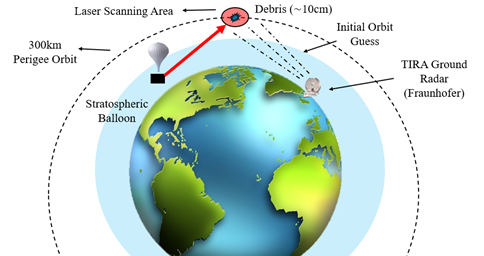
Complementary lab work will optimize the laser for stratospheric conditions, enhance UV conversion, and explore scalability. Mission analysis will evaluate post-ablation trajectories, aiming for a €2.5K cost per debris object removed.
The project is led by the GRVC Robotics Lab and AICIA, with B2Space providing stratospheric balloon platforms and system design expertise, Fraunhofer FHR adapting radar techniques for orbit estimation and on-board tracking, HiLASE contributing expertise in laser ablation and high-power system design, CLPU advancing optoelectronics and ultra-short pulse research for debris ablation, and Sapienza University supporting orbital mechanics and mission analysis.
 Stratolaser